Occupational Therapy vs Physiotherapy
- October 12, 2026
- admin
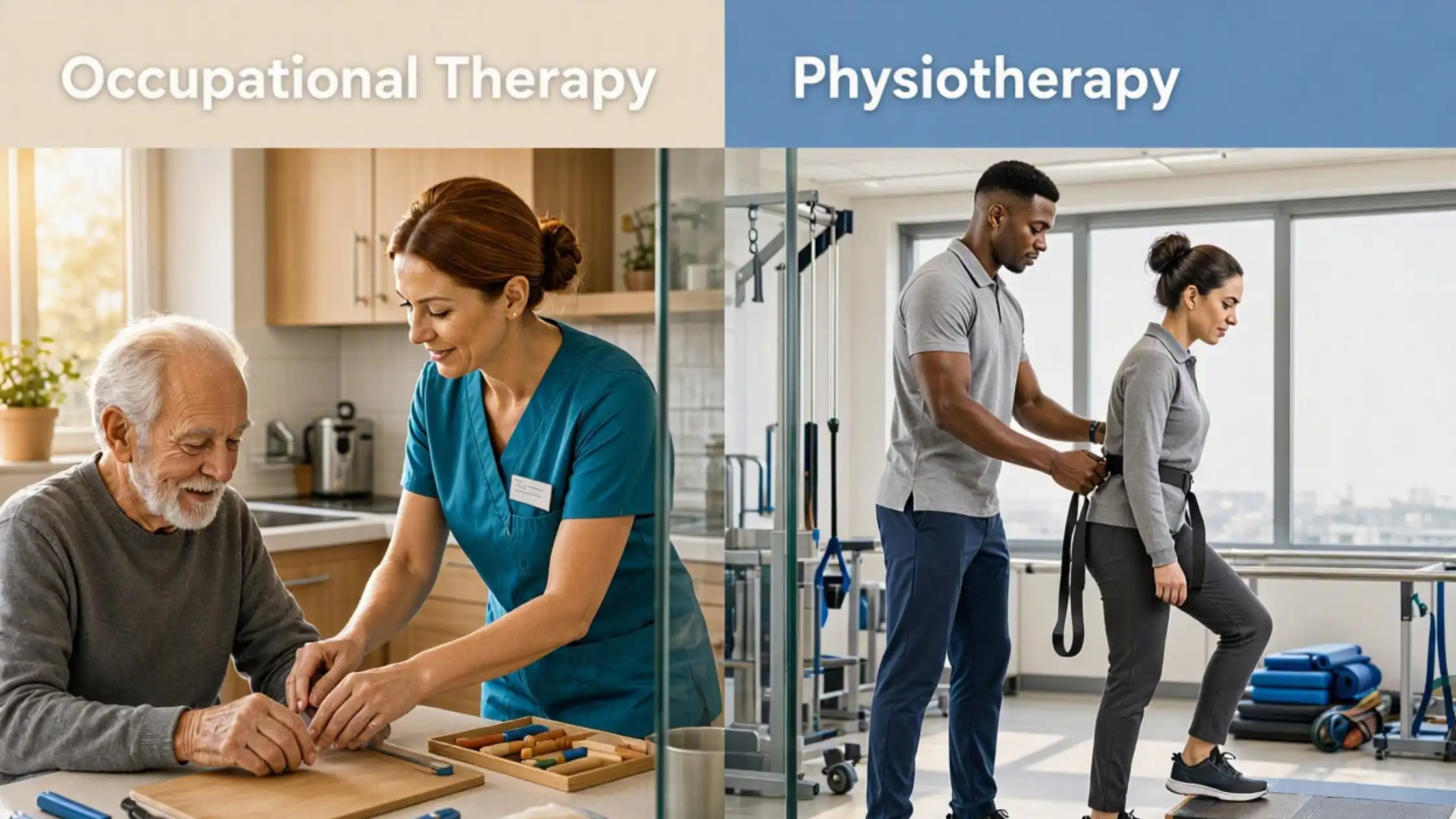
When someone is recovering from a stroke, injury, surgery, neurological condition, or a long-term health problem, rehabilitation can involve several different types of therapy. Two of the most commonly recommended are occupational therapy and physiotherapy.
Although both aim to improve a person’s function and independence, they do not have exactly the same purpose. This often leads patients and caregivers to ask: What is the difference between occupational therapy and physiotherapy? And more importantly, which one is needed?
The answer depends on the person’s condition, limitations and rehabilitation goals.
Physiotherapy generally focuses on movement, physical strength, balance, mobility and the ability to perform physical activities. Occupational therapy, on the other hand, focuses more on helping a person perform everyday activities and regain independence in daily life.
In many situations, however, the two therapies work best together. For example, a person recovering from a stroke may need physiotherapy to improve walking and balance while occupational therapy helps them relearn activities such as dressing, eating, bathing or using their hands effectively.
Understanding the difference between occupational therapy vs physiotherapy can help patients and families understand what each professional does and why both may be included in a comprehensive rehabilitation programme.
What Is Physiotherapy?
Physiotherapy, also known as physical therapy, is a rehabilitation approach that focuses primarily on movement and physical function.
A physiotherapist assesses problems involving muscles, joints, nerves, balance and movement and develops an individualised treatment plan based on the person’s needs.
Physiotherapy may be recommended after:
- Stroke
- Fractures
- Joint replacement
- Sports injuries
- Spinal cord injuries
- Neurological conditions
- Musculoskeletal problems
- Surgery
- Chronic pain
- Balance and mobility problems
- Certain childhood developmental conditions
The goal is not simply to exercise a particular muscle. Physiotherapy often aims to help a person move more safely and efficiently and regain as much physical function as possible.
What Does a Physiotherapist Do?
Depending on the condition, physiotherapy may involve:
- Strengthening exercises
- Stretching and flexibility exercises
- Balance training
- Gait training
- Mobility exercises
- Joint mobilisation
- Neurological rehabilitation
- Postural training
- Functional movement training
- Pain-management techniques
- Cardiopulmonary rehabilitation
- Exercise programmes for home
For example, after a stroke, a physiotherapist may work on sitting balance, standing, weight shifting, walking, stair climbing and lower-limb control.
The exact treatment varies significantly from one patient to another.
What Is Occupational Therapy?
Occupational therapy (OT) is a rehabilitation profession that helps individuals participate in meaningful daily activities and achieve the highest possible level of independence.
The term “occupation” refers not only to employment but to the activities people need, want, or are expected to perform. These may include eating, dressing, bathing, grooming, writing, studying, working, cooking, playing, managing a household, and participating in family or community life.
An occupational therapist evaluates how physical, cognitive, sensory, visual-perceptual, and psychosocial factors affect a person’s ability to perform these activities.
Treatment may include restoring functional abilities, practising meaningful activities, developing compensatory strategies, adapting tasks, or modifying the environment to promote safety, independence, and participation.
The ultimate goal is not merely to improve an isolated skill, but to enable the individual to apply their abilities effectively in everyday life.
Occupational therapy may be useful for people recovering from:
- Stroke
- Brain injury
- Spinal cord injury
- Neurological disorders
- Hand injuries
- Developmental conditions
- Fractures
- Surgery
- Cognitive difficulties
- Physical disabilities
- Conditions affecting independence and daily functioning
What Does an Occupational Therapist Do?
An occupational therapist may work on:
- Activities of daily living (ADLs), including dressing, bathing, feeding and grooming
- Instrumental activities of daily living (IADLs), such as cooking, shopping, household management and medication routines
- Upper-limb rehabilitation and functional arm use.
- Hand function, grasp and release .
- fine motor skills and dexterity.
- Bilateral coordination .
- Visual-perceptual
- Functional reaching, grasping and object manipulation
- Cognitive skills, including attention, memory, planning and problem-solving
- Visual-perceptual skills and visual-motor skills.
- Cognitive rehabilitation including attention, memory and problem-solving.
- Sensory processing and sensory regulation
- Functional mobility and transfer skills related to daily activities.
- Work, school, leisure and community participation
- Energy conservation and activity management
- Adaptive equipment and assistive technology
- Home safety and environmental modifications
- Caregiver education and training
- Development of compensatory strategies to support independence.
For a stroke survivor, this could mean practising how to put on a shirt using one hand, safely transfer from a bed to a chair, prepare a simple meal or use utensils.The primary focus is on making everyday life more manageable and meaningful.
What Else Does Occupational Therapy Address?
Occupational therapy can address a wide range of physical, cognitive, sensory and functional difficulties that affect participation in everyday life.
It may include:
Cognitive rehabilitation; attention, memory, sequencing, problem-solving and executive functions
Visual-perceptual rehabilitation; visual scanning, spatial awareness, perception and visuomotor skills
Upper-limb and hand rehabilitation; reaching, grasping, coordination and functional hand use
Activity adaptation and compensatory strategies; modifying how a task is performed when abilities are affected
Adaptive equipment and assistive technology; selecting and training in equipment that supports safety and independence
Environmental modifications; adapting the home, workplace or other environments to improve accessibility and participation
Sensory processing and regulation;particularly relevant in paediatric and neurological rehabilitation.
Occupational Therapy vs Physiotherapy: The Main Difference
The easiest way to understand occupational therapy vs physiotherapy is to look at what each profession primarily aims to improve.
Physiotherapy focuses mainly on movement and physical function.
Occupational therapy focuses mainly on performing meaningful everyday activities and maintaining independence.
However, there is considerable overlap between the two.
Physiotherapy | Occupational Therapy |
Focuses on movement and physical function | Focuses on daily activities and functional independence |
Improves strength and mobility | Improves the ability to perform everyday tasks |
Includes gait and balance training | Includes self-care and activity-based training |
Works extensively on lower-limb function | Addresses physical, cognitive, sensory and visual-perceptual barriers to occupational performance |
Helps improve physical mobility | Helps people participate in meaningful everyday activities by activity adaptation,compensatory strategies and environmental modifications. |
May address pain and movement limitations | May address physical, cognitive, sensory and visual-perceptual difficulties |
Can help with walking and transfers | Supports participation in self-care, work, education, leisure and everyday activities |
May recommend mobility-related strategies | May recommend adaptive equipment and environmental modifications. |
This table provides a general comparison, but real rehabilitation is not always divided into such clear categories. Physiotherapists and occupational therapists often collaborate and may work toward the same functional goal from different perspectives.
Occupational Therapy vs Physiotherapy After a Stroke
Stroke is one situation where the difference between the professions becomes particularly clear.
A stroke can affect movement, balance, coordination, strength, speech, cognition and the ability to perform everyday activities.
Physiotherapy after stroke
Physiotherapy may focus on:
- Improving muscle strength
- Improving balance
- Retraining walking
- Improving transfers
- Practising standing
- Improving coordination
- Managing movement difficulties
- Reducing physical limitations
- Improving endurance
- Preventing complications related to immobility
For example, a patient who cannot walk independently may work with a physiotherapist on standing balance, stepping and gait training.
Occupational therapy after stroke
Occupational therapy may focus on:
- Improving functional use of the affected upper limb during reaching, grasping and object manipulation
- Practising dressing, grooming, feeding and bathing
- Developing compensatory techniques when full movement recovery is not yet possible
- Improving coordination and fine motor skills required for everyday tasks
- Addressing cognitive, sensory and visual-perceptual difficulties
- Training in safe transfers and functional mobility during daily activities
- Recommending adaptive equipment and environmental modifications
- Supporting return to household activities, work and community participation
The therapist selects interventions according to the person’s abilities, functional limitations and meaningful rehabilitation goals.
Why both may be needed
The two therapies can complement each other.
Imagine a person recovering from a stroke who has difficulty walking from the bedroom to the bathroom.
The physiotherapist may focus on how the person walks – strength, balance, foot placement and safe mobility.
The occupational therapist may focus on how the person manages the bathroom activity, transferring safely, managing clothing, using the toilet and adapting the environment if necessary.
This is why asking which therapy is “better” is often less useful than asking what the patient needs help doing.
Occupational Therapy vs Physiotherapy for Neurological Conditions
Both professions play an important role in neurological rehabilitation.
Conditions such as stroke, Parkinson’s disease, multiple sclerosis, spinal cord injury, traumatic brain injury and other neurological disorders can affect multiple aspects of functioning.
Physiotherapy may help with:
- Walking difficulties
- Balance problems
- Muscle weakness
- Coordination
- Mobility
- Transfers
- Posture
- Muscle tone
- Physical endurance
Occupational therapy may help with:
- Self-care
- Hand function
- Upper-limb use
- Fine motor skills
- Cognitive difficulties
- Daily routines
- Household activities
- Work-related activities
- Environmental adaptations
- Independence
Because neurological conditions can affect several areas simultaneously, rehabilitation is often more effective when different professionals coordinate their care.
Occupational Therapy vs Physiotherapy for Children
Children may also receive physiotherapy, occupational therapy or both depending on their developmental and functional needs.
Physiotherapy for children
Paediatric physiotherapy may focus on:
- Gross motor development
- Strength
- Balance
- Walking
- Coordination
- Posture
- Mobility
- Physical activity
For example, a child experiencing delayed motor development may receive physiotherapy to improve sitting, standing, walking or other gross motor skills.
Occupational therapy for children
Paediatric occupational therapy may focus on:
- Supports age-appropriate play, learning and daily routines.
- Develops fine motor skills, hand-eye coordination and bilateral coordination.
- Supports handwriting and pre-writing skills.
- Addresses visual-motor integration and motor planning.
- Supports sensory processing and regulation.
- Addresses feeding and self-care skills.
- Promotes participation in school and classroom activities.
- Consider the child’s developmental abilities, family priorities and environmental needs when planning intervention.
A child may therefore benefit from both therapies when developmental difficulties affect both gross motor movement and everyday functional skills.
Is Occupational Therapy the Same as Physiotherapy?
No. Occupational therapy and physiotherapy are different rehabilitation professions, although they can overlap.
Physiotherapy generally places greater emphasis on physical movement, mobility, strength, balance and physical function.
Occupational therapy generally focuses on helping a person participate in everyday activities and become as independent as possible.
However, neither profession works in isolation. In a rehabilitation setting, therapists may communicate with one another and coordinate treatment around the patient’s overall goals.
For example, improving arm movement may be a physiotherapy goal, while using that improved arm movement to eat independently may become an occupational therapy goal.
When Is Physiotherapy Recommended?
Physiotherapy is often appropriate for concerns that primarily affect movement and physical functioning.
A healthcare professional may recommend physiotherapy for problems such as:
- Difficulty walking
- Muscle weakness
- Poor balance
- Reduced joint movement
- Difficulty standing
- Problems with transfers
- Recovery after surgery
- Sports injuries
- Certain neurological conditions
- Chronic musculoskeletal problems
- Reduced physical endurance
The treatment plan depends on the diagnosis and the individual’s functional limitations.
When Is Occupational Therapy Recommended?
Occupational therapy may be useful when a person has difficulty carrying out everyday activities independently.
It may be recommended when someone struggles with:
- Dressing
- Eating
- Bathing
- Grooming
- Writing
- Using their hands
- Cooking
- Household activities
- Returning to work or school
- Cognitive tasks
- Managing daily routines
- Performing activities safely after an injury or neurological condition
Occupational therapy is particularly valuable when a person’s condition has changed what they can do independently.
Can Someone Need Both Occupational Therapy and Physiotherapy?
Yes. In fact, many rehabilitation patients benefit from both.
This is particularly common after a stroke, spinal cord injury, traumatic brain injury or major orthopaedic injury, where both physical mobility and everyday function may be affected.
Consider a person recovering from a stroke who has weakness on one side.
Physiotherapy may help improve:
- Standing
- Walking
- Balance
- Lower-limb strength
- Transfers
Occupational therapy may help improve:
- Dressing
- Eating
- Hand function
- Personal care
- Household tasks
- Safe use of the affected arm
Together, these approaches can address different parts of the person’s recovery.
The aim is ultimately not just to improve movement in a therapy room, but to help the person use that movement in real-life situations.
How Do Occupational Therapists and Physiotherapists Work Together?
Good rehabilitation is often collaborative.
A patient may have a single broad goal, such as “I want to become independent at home.”
The physiotherapist and occupational therapist may approach this goal differently.
The physiotherapist may work on:
- Walking safely
- Standing balance
- Strength
- Transfers
- Stair climbing
The occupational therapist may work on:
- Dressing and self-care
- Functional use of the upper limb
- Preparing and eating meals
- Household activities
- Cognitive or sensory difficulties
- Adapting activities and the home environment
Both therapists can communicate their findings and coordinate treatment as the person’s abilities and goals change. This collaborative approach is an important part of multidisciplinary rehabilitation.
What Happens During a Physiotherapy Session?
A physiotherapy session usually begins with an assessment of the patient’s movement and physical abilities.
Depending on the condition, the therapist may assess:
- Muscle strength
- Range of motion
- Balance
- Walking ability
- Coordination
- Posture
- Pain
- Functional mobility
Treatment may then include exercises, movement practice, gait training, balance activities or other appropriate rehabilitation techniques.
The programme is adjusted according to the person’s progress.
What Happens During an Occupational Therapy Assessment?
An occupational therapy assessment may focus on the activities the patient needs or wants to perform in everyday life.
The therapist evaluates:
- Hand and upper-limb function
- Fine motor skills and coordination
- Self-care abilities
- Cognitive skills
- Sensory and visual-perceptual difficulties
- Functional task performance
- Home and environmental factors
- Work,school,and leisure activities.
An occupational therapy assessment may also explore:
- The person’s previous and current daily routines
- Activities they need or want to perform
- Level of assistance required for everyday tasks
- Ability to initiate, sequence and complete activities
- Performance in familiar and unfamiliar environments
- Family and caregiver support
- Personal goals and priorities
Treatment may involve practising everyday tasks, improving hand function, developing compensatory strategies or recommending adaptive equipment.
The therapist may observe the person performing actual functional activities to identify barriers and determine appropriate intervention strategies.
The focus is practical: How can this person participate more safely, independently and meaningfully in everyday life?
What Is the Role of Rehabilitation in Recovery?
Rehabilitation goes beyond treating an injury or disease. Its goal is to help a person restore their abilities and achieve the best possible level of function after experiencing a health condition or physical limitation.
Depending on the individual’s rehabilitation needs, treatment may focus on:
- Mobility
- Independence
- Strength
- Balance
- Self-care
- Communication
- Cognition
- Physical endurance
- Social participation
- Return to work or education
This is why rehabilitation plans are often individualised rather than based on a standard set of exercises.
Two people with the same diagnosis may have completely different rehabilitation goals.
Occupational Therapy vs Physiotherapy: Which One Do You Need?
There is no universal answer.
The right therapy depends on what the person is struggling with and what they want to achieve.
If the main problem is:
Walking, balance, strength, mobility or physical movement → Physiotherapy may be particularly relevant.
If the main problem is:
Self-care, physical function, upper-limb and hand function, fine motor skills, cognitive or sensory difficulties, daily activities or independence → Occupational therapy may be particularly relevant.
If both physical movement and daily activities are affected, both occupational therapy and physiotherapy may be recommended.
Some people may benefit from occupational therapy, physiotherapy or both. When multiple areas of function are affected, the two professions can work together as part of a coordinated rehabilitation programme.
A doctor, Physical Medicine and Rehabilitation (PMR) specialist or rehabilitation team can assess the person’s needs and recommend an appropriate rehabilitation plan.
Occupational Therapy and Physiotherapy at Garden PMR Hospital
Supporting Recovery Through Multidisciplinary Rehabilitation
At Garden PMR Hospital, rehabilitation is designed around the individual needs and functional goals of each patient.
The hospital provides rehabilitation services involving Physical Medicine and Rehabilitation (PMR), physiotherapy, occupational therapy, speech therapy and other supportive services, depending on the patient’s condition.
Garden’s rehabilitation programmes are particularly relevant for patients recovering from neurological and physical conditions such as stroke, spinal cord injury, Parkinson’s disease, cerebral palsy and other conditions that can affect movement and independence.
For example, after a stroke, physiotherapy may focus on mobility, balance, walking and physical function, while occupational therapy can address upper-limb use, self-care and activities of daily living. Garden’s stroke rehabilitation programme includes mobility training, balance work, physiotherapy, occupational therapy and functional rehabilitation as part of a multidisciplinary approach.
The hospital also provides specialised services in neurological rehabilitation, paediatric rehabilitation, orthopaedic rehabilitation and other areas of physical medicine and rehabilitation.
Rather than treating physiotherapy and occupational therapy as competing options, a multidisciplinary rehabilitation team can use both approaches when appropriate, addressing the physical limitations as well as the practical challenges that affect everyday life.
Final Thoughts
The discussion around occupational therapy vs physiotherapy should not be viewed as a competition between two types of treatment. They are different but complementary rehabilitation professions.
Physiotherapy primarily helps people improve movement, strength, balance, mobility and physical function.
Occupational therapy helps individuals develop, regain or adapt the skills needed to participate in everyday activities and achieve greater independence.
For some patients, one type of therapy may be sufficient. For others, especially those recovering from stroke, neurological disorders, spinal cord injuries or significant physical injuries, combining both can provide a more complete rehabilitation programme.
The important question is not simply, “Should I choose occupational therapy or physiotherapy?” but rather:
“What difficulties am I experiencing, and what do I need to be able to do more safely and independently?”
A proper rehabilitation assessment can help identify those needs and determine the most appropriate therapy or combination of therapies.
With personalised treatment, consistent practice and the right professional support, rehabilitation can help people work toward greater independence and a better quality of everyday life.
FAQs
Neither is universally better. They have different purposes. The appropriate therapy depends on the person's condition, functional limitations and rehabilitation goals.
Yes. Many patients may benefit from both therapies, particularly after stroke, spinal cord injury, brain injury and other conditions that affect mobility, physical function and everyday activities. Physiotherapists and occupational therapists can work together as part of a multidisciplinary rehabilitation team, with treatment tailored to the person's individual goals and needs.
Both may be important after a stroke, depending on the person's impairments and rehabilitation goals. Physiotherapy may focus on mobility, balance, strength, coordination and walking, while occupational therapy may address upper-limb and hand function, self-care, cognitive and visual-perceptual skills, and everyday activities. Some people may benefit from both as part of a coordinated rehabilitation programme.
Yes. Improving strength, balance, mobility and transfers through physiotherapy can help a person perform daily activities more safely and independently. Occupational therapy may provide more specific training in activities such as dressing, bathing, grooming and eating, as well as strategies or adaptations to support functional independence.
Occupational therapists work with people who experience difficulties performing everyday activities due to physical, neurological, cognitive, sensory, developmental or environmental challenges. They help improve functional skills, develop compensatory strategies, adapt activities and environments, and support greater independence in daily life.
There is no fixed duration. The length and frequency of rehabilitation depend on the diagnosis, severity of impairment, treatment goals and progress. The rehabilitation team can determine an appropriate schedule after assessment.